
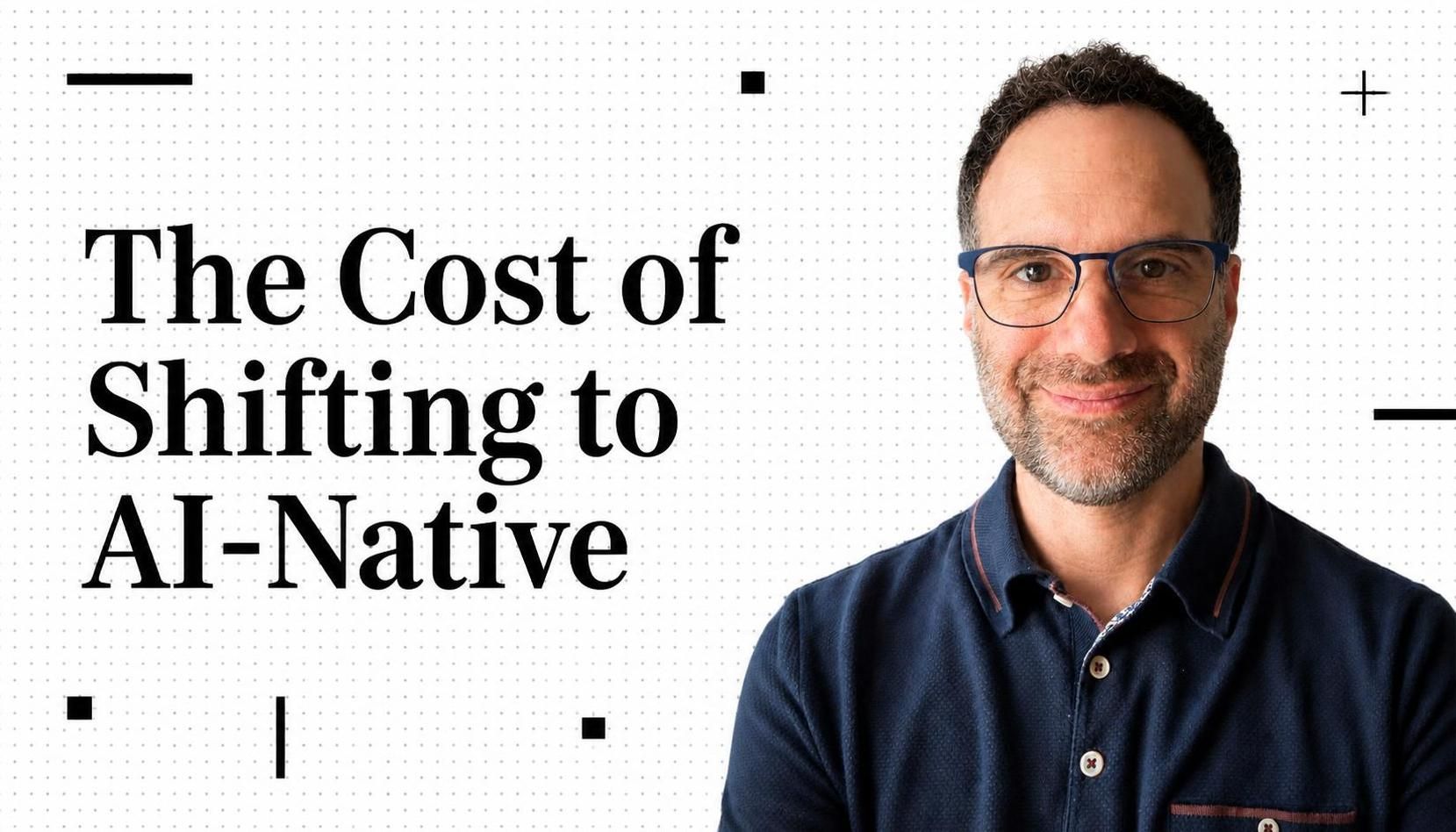
On February 5th, Sylvain Laporte was in the middle of engineering work using Claude Code. He noticed Opus 4.6 had been released and switched to the new model. He looked at the output.
Nothing to correct. Nothing to push back on. No notes.
He messaged Co-Founder Peter Pang to tell him about the results. Peter wrote back: they were about to enter self-evolving AI. They needed to shift CREAO's approach, and they needed to move fast. That same day, Peter dropped everything and started a side project to rebuild the entire architecture of the stack.
I chatted with Sylvain, self-titled as Chief AI Wrangler, to understand how the decision to change CREAO from a vibe-coding tool to a self-healing agent platform came about and what it cost.
TL;DR — What is an AI-native company?
AI-native means directing AI systems that run your work rather than using AI for individual tasks. That depends on how the work underneath is organized. The businesses getting the most out of current models reorganized their work so AI could operate inside it, then built from there.
How Sylvain Laporte Landed at CREAO
Sylvain Laporte has been building AI systems since before the current wave. He ran the AI research lab and then became CTO at a customer experience and voice of customer technology company, where the machine learning system he managed processed over a billion unique visitors a day. He has also produced games at EA and spent years as CEO of Spacemoose, building AI for the gaming and pro cycling industries.
At CREAO, Sylvain works across engineering and go-to-market, which makes him one of the few people who can describe what changed in the architecture and what it did to the pipeline.
Around 2021, a colleague introduced him to Peter Pang, who was working at Meta at the time.
Jen: So where did you come in?
Sylvain: I introduced Peter to Kai Cheng, now CREAO's co-founder and CEO. Kai had worked with Lane and me back in 2015 at another company. Peter flew out, they met, and a couple of years later they founded CREAO.
What Changed in How CREAO Builds?
When Peter wrote back to Sylvain's note about Opus 4.6, nothing in CREAO's architecture was broken. The old structure was working the way distributed codebases do, dozens of separate repositories, each self-contained, each part of the team in its own corner. Peter started the rebuild anyway.
Jen: What was the structural issue with the old setup and previous way of working?
Sylvain: It encouraged the old way of working in software where each contributor focuses on their craft and is somewhat removed from the needs of the customers. While engineers, PMs, designers have always been encouraged to "go to the users" and tease out the need behind the need, as I like to say, it was becoming clear that AI coding agents would allow you to remove these boundaries between roles to a great extent. Really a tide that lifts all boats in enabling all crafts to come closer to the users and build on a new platform at an unprecedented pace and level of quality. That said, for this to truly work we needed to build an architecture where AI coding agents could be main characters, not just NPCs.
Jen: So what replaced it?
Sylvain: First we went with a monorepo instead of polyrepo approach. And if you're an engineer, I know, monorepo versus polyrepo is an old debate and not a very exciting one. But the consolidation was never the point. It was the foundation for a different bet: that the codebase should be something you teach. The thing about AI coding agents is, roughly, that they wake up every session knowing nothing or almost nothing let's say. A new engineer gets months to absorb how we work; the agent gets seconds. So everything a veteran carries in their head, where things live, how we ship, what good looks like here, the mistakes we've already made once, has to live in the repo itself. We built skills around it, small packaged playbooks the agent pulls in when it's building a feature. And because agents move fast, the safety net can't be a person checking everything by hand. Every change, whether a human or an agent wrote it, goes through the same pipeline of automated AI checks before it gets anywhere near a customer. It even watches itself in production and when something breaks, it diagnoses the problem and proposes the fix on its own. All of these things only compound in one well-structured place. That monorepo just cleared the stage so the agents could be main characters and honestly watching this every day still feels like science fiction to me.
The same problem shows up in the product, which is why memory sits underneath it. More on what the rebuild produced in how CREAO built an agent platform that evolves with AI.
Jen: What did the rebuild make possible?
Sylvain: It enabled us to ride the exponential. It's what lets us keep users at the frontier of AI.
Riding the exponential is a phrase you hear a lot in AI circles. It means the ground under a product keeps moving, so you build something that can take the next model without starting over. 50 repositories could not do that. But one can.
What Did the Rebuild Cost?
Jen: Was there pushback?
Sylvain: There was. It really took a while for everyone to rally behind this vision. In part because people were camped in their old ways of working, in part because it was such a big leap and thus scary for a lot of people. Regardless, Peter's position was that to ride the exponential, we had to rethink everything. Equipping developers with better tooling would just make that one piece bigger and bog everything else down. So we had to redo everything. That took a while for us internally to latch onto. For a long time it was just Peter. Then Peter and me. Peter and I had to do a lot of evangelizing internally.
Jen: What did that mean for the business?
Sylvain: We ultimately had to let go of a significant chunk of recurring revenue we had from the previous platform. But there was no way we could deliver on the promise of keeping our customers at the frontier working the way we had been, which was similar to any other engineering firm. Pitches, requirements, specs, design documents, meetings and meetings and meetings. That was built for humans doing every single thing. You see it in this field, where some companies get the new models really late. For the important ones, we're almost always on day one.
Jen: So you not only changed the product, you also changed how you made the product.
Sylvain: Yes, two shifts in one. The first was transforming the company to AI-native. The second was changing what we delivered to users, moving from vibe-coded apps to agents. A vibe coding platform builds software in a very traditional way, so it can't be nimble enough to match your specific workflows. It works for limited use cases and every edge case becomes a nightmare. Over time you end up maintaining your own brittle SaaS. An agent is less deterministic, though we have ways to tighten that, and it's far more resilient when something changes.
Most companies would attempt one of those changes at a time. Doing both meant the thing they were selling and the way they built it were being replaced at once.
What Do Most Companies Get Wrong About AI?
Jen: What's the mistake you often see when teams start adopting AI?
Sylvain: They automate the one piece of the workflow they already understand. The most comfortable piece. And they stop there. For us, we could have said Opus 4.6 is amazing, let's make sure all our developers have good tooling. Do the token maxing thing.
Token maxing is the practice of giving engineers unlimited model usage and treating the output volume as progress.
Sylvain: You just end up with the bottleneck. You can ship more code, but then you have to put it into production. Whether it's code written by a human or by AI, it's always buggy or flawed. Always. You need to think of the whole workflow, end to end.
Jen: Does this hold for a team that isn't building a platform like CREAO?
Sylvain: Say you're starting an engineering consulting firm and you want it to be AI-native. You automate the process of doing RFPs, but everything else stays manual. You're not going to get far. You moved the bottleneck downstream.
The same thing happens at a smaller scale. A one-person business that has set up AI for proposals, then left intake, follow-up, and delivery untouched, has moved its bottleneck from writing proposals to everything that surrounds them.
CREAO put down a platform that was earning money because it could not keep up with what was coming. Rebuilding one part of it would have left the rest where it was, so the company and the product got rebuilt together. That is what going AI-native took here.
Ready to build AI-native? See how CREAO runs the whole workflow →
Jen Watters is a content strategist at JenAI working with the CREAO team. Read the earlier conversations of the Behind the Agents series in Related Reading.
Related Reading
The Case for Remembering: Why Memory Is the Missing Layer in AI
Behind the Agents: What Running an AI-Native Company Looks Like, with Co-Founder & CPO Clark Gao
Frequently Asked Questions
Q: What is an AI-native company?
A: An AI-native company directs AI systems that run its work rather than using AI for individual tasks. That shift depends on how the underlying work is organized. CREAO rebuilt its codebase as a single structured repository so AI could work in it as a primary contributor.
Q: How is AI-native different from using AI tools?
A: AI tools speed up specific tasks inside a workflow that stays the same. AI-native means the workflow itself is designed around AI participation, from the structure of the work up. You can usually tell which one you're looking at by whether the surrounding work got reorganized or stayed put.
Q: What does moving the bottleneck mean?
A: When one part of a workflow gets automated and the rest stays manual, the constraint shifts to the next step. Generating code faster makes testing and deployment the new limit. Total throughput barely changes because the slowest step was never the one that got automated.
Q: How do you start building an AI-native business?
A: Map the full workflow, beginning to end, then design AI participation across it. Automate the piece you already understand and leave the rest alone, and you get one fast step in a slow workflow. Most of the difficulty sits at the handoffs, where work loses context moving from one step to the next.
Q: What should someone new to AI agents look for in a platform?
A: Coverage across the whole path, from conversation to reusable agents that run on a schedule. Most tools handle one or two stages, which means context gets rebuilt every time work moves between them. Ask what happens to what the platform learned in the first run by the time you reach the tenth.